Roads Less Traveled | Cycling Through Le Marche, Italy
Some destinations are personal.
Le Marche is that place for me. My family roots trace back to this region — my grandparents, who spoke mostly Italian to each other, peppered our home with the word "Marchigian." On the table were dishes I knew by their dialect names before I ever knew their Italian ones. That was my first introduction to Le Marche, long before I ever set foot there.
I've now been back twice. This August, I'm going for the third time — exploring new territory in the south, on a five-day cycling loop through some of the region's most beautiful and least-traveled corners. And I keep asking myself why more travelers haven't discovered this place.
What Le Marche Is — and Why It Matters
Le Marche occupies the central Adriatic coast of Italy, sandwiched between Emilia-Romagna to the north and Abruzzo to the south, with the Apennine Mountains rising to the west and the Adriatic Sea to the east. It is, geographically, one of the most varied regions in Italy — beaches, rolling hills, medieval hilltop towns, and mountain terrain that feels like another world entirely, sometimes all within the same day's ride.
What it is not: crowded. While summer tourists fill Tuscany, the Amalfi Coast, and the Cinque Terre, Le Marche moves at its own pace. It always has. The roads are quieter. The towns are less aware of being picturesque. The restaurants are cooking for locals first. That's what makes it feel like the real Italy — the one that existed before the guidebooks arrived.
The Route: Five Days Through the South
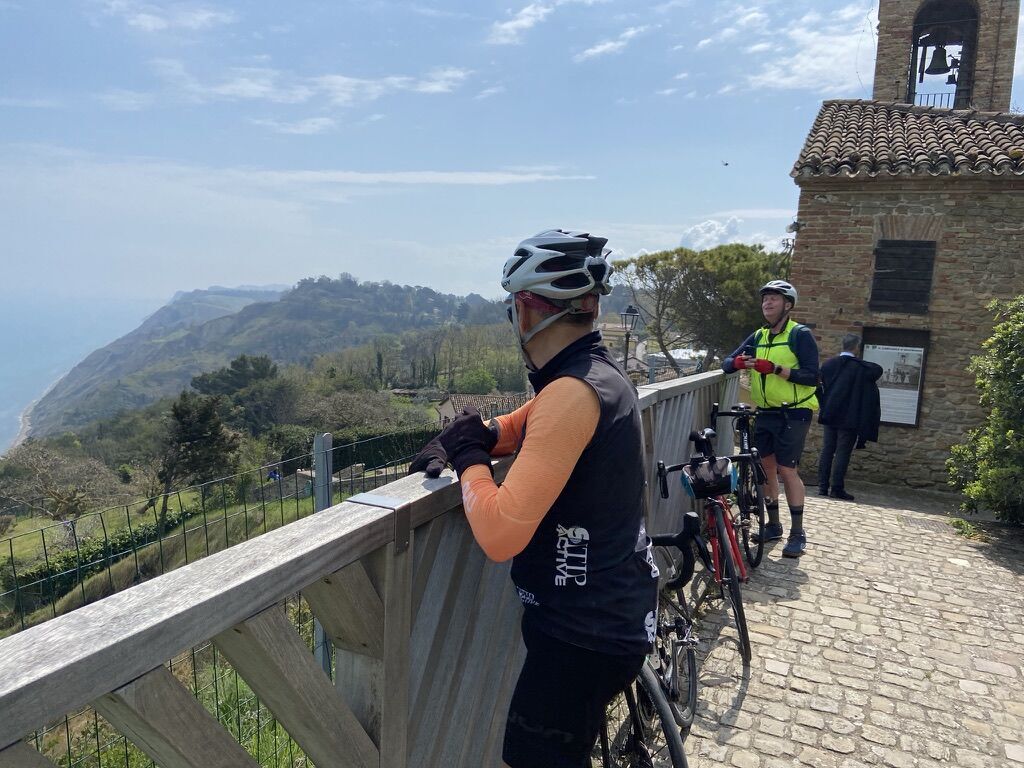
This August's loop takes in a stretch of the region I haven't fully explored: south from Fermo along the Adriatic, then inland through the hills, up toward the mountains, and back again.
Fermo and Torre di Palme — Fermo is a hilltop city with a remarkable Roman cistern beneath it, a cathedral, and the kind of main square where nothing seems urgent. Torre di Palme, a few kilometers toward the sea, is one of the smallest and most beautiful villages in Italy — a cluster of stone buildings on a promontory above the Adriatic, with views that stop you mid-pedal.
Campofilone — A name known to pasta obsessives. Maccheroncini di Campofilone — egg pasta cut so thin it almost dissolves in the sauce — has been made here for centuries. We'll make it. There's no other way to understand it properly.
Grottamare and the Adriatic coast — A quieter version of the Italian beach experience. Elegant, unpretentious, entirely local in character.
Ascoli Piceno — The architectural jewel of Le Marche. The Piazza del Popolo — built in travertine marble, lined with Gothic and Renaissance arcades — is among the most beautiful town squares in Italy. Ascoli is also the home of olive ascolane: giant green olives stuffed with spiced meat, breaded, and fried. They are, without qualification, one of the great things to eat in Italy. We'll be staying at Palazzo dei Mercanti, a converted medieval convent in the historic center — the kind of property that makes you want to stay an extra day.
Offida — A small hilltop town known for its lacemaking, its carnival, and its wine. The Rosso Piceno produced in this zone — a blend of Montepulciano and Sangiovese — is serious, underpriced, and pairs well with whatever the kitchen produces. We'll sip some.
Communanza and Castellucio — The route climbs into the Sibillini Mountains toward Castellucio, the high alpine plain that floats above the surrounding valleys at 1,450 meters. In early summer the plain blooms into a carpet of wildflowers that is genuinely difficult to describe. By August, the flowers are gone, but the landscape — vast, quiet, exposed — remains one of the most singular things I've seen in Italy.
Cycling Le Marche
The roads through Le Marche's interior are among the best cycling roads in Italy — varied terrain, light traffic, and a landscape that changes constantly. The coast road offers flatter riding; the inland hills and mountain approaches offer everything from moderate climbs to serious efforts. The route can be shaped around fitness level and preference.
Guiding this trip is Luca Pelliccetti of CTF Travel, based in Fermo — as skilled a local cycling guide as you'll find anywhere in Italy, and an even better ambassador for everything that makes this region warm and genuine. He knows these roads the way you know your own neighborhood.
Why Le Marche Belongs on Your Italy List
For a traveler who wants to go deeper into Italy — who has done Tuscany and the Amalfi Coast, who wants something more real, more local, more surprising — Le Marche delivers consistently. The food is extraordinary. The cycling is excellent. The towns are alive rather than preserved. And the people, who haven't spent thirty years managing tourists, are simply happy to see you.
My family knew something when they left this place and still talked about it every day. The region has that quality — it stays with you.
This is part of my ongoing effort to go deeper into Italy's lesser-known destinations, bringing back firsthand knowledge to design the best possible active experiences for my clients. Le Marche is not a compromise or an alternative to somewhere better. It is somewhere better.
If Le Marche has been on your radar — or if this is the first time you've heard of it — I'd love to talk about building a trip there.
Reach out through the contact page. There's a lot more to come from Le Marche.